

- By Smile Roofing
- Roofing Tips
- 0 Comment
Durability on a Flat Roof Means “Failure Resistance,” Not a Marketing Number
Flat roofs and low-slope roofs do not usually fail because a membrane “gets old.” They fail because water finds a pathway, and the pathway almost always starts at a seam, an edge, a penetration, or a drainage point. At Smile Roofing, we look at durability as the roof’s ability to resist the most common failure mechanisms that show up on real buildings, under real rooftop use, through seasonal heat swings and weather events.
The durability signals that predict performance on low-slope systems
Seam integrity under stress
For single-ply membranes, seams are the roof. If seams separate, water intrusion can happen long before the field membrane looks worn. Durability rises sharply when seam performance is consistent and verifiable.
Puncture and impact resistance
Rooftops attract foot traffic. HVAC techs, plumbers, solar installers, and even homeowners checking equipment can introduce punctures. A “durable” flat roof material is one that tolerates incidental abuse and can be repaired without creating new weak points.
Ponding-water tolerance and drainage reality
Low-slope roofs often hold water temporarily, especially when drains clog or slope is minimal. Materials vary in how they behave under standing water and hydrostatic pressure. Durability improves when the system is designed to manage water instead of hoping water will never sit.
UV and heat cycling performance
High UV and repeated heat cycling can harden materials, stress seams, and accelerate surface aging. A durable roof system controls heat load and remains stable through temperature swings.
Repair compatibility over time
Durability is also about what happens later. If a puncture occurs, can the material be repaired cleanly with compatible methods and readily available components, without guessing or improvising?
The installation multiplier that changes every ranking
Even the highest-ranked membrane can underperform if detailing is weak. The same material can behave like two different products depending on how transitions, penetrations, edge securement, and drainage corrections are handled. When we evaluate a roof, we do not start with a brand brochure. We start with the building, the slope, the water exit points, and the rooftop behavior that will stress the system the most.
If you are deciding between materials, it helps to start from roof-specific conditions and options rather than a generic product list. Our team approaches this through our flat roof replacement service options so the material choice matches drainage, penetrations, and rooftop use instead of fighting them.
How We Rank Flat Roof Materials by Durability
A durability ranking becomes useful when it reflects what actually breaks first. Our ranking is built around failure pathways and the degree of control you can realistically maintain over those pathways.
The five durability categories behind the ranking
Seams and terminations
How the roof closes its joints and edges is a defining durability variable. Welded seams behave differently than taped seams, and both behave differently than multi-ply assemblies.
Flashings and penetrations
Pipe boots, curbs, skylights, parapet walls, and edge metal are where most leak calls originate. The most durable systems are those that integrate these details cleanly and predictably.
Surface resilience to traffic and incidental damage
Some materials shrug off scuffs and minor impacts. Others perform well only when walk paths and protection zones are planned up front.
Water-management tolerance
This is not permission for ponding water. It is a recognition that water behavior is imperfect, and the best systems handle real-world water conditions without rapidly degrading.
Long-term repairability
The most durable roof is not the one that never needs attention. It is the one that can be repaired correctly when something happens, without creating a patchwork of incompatible materials.
What shifts a material up or down the list
Material thickness, reinforcement, attachment strategy, cover boards, and workmanship all shift durability. Two roofs labeled “TPO” can perform very differently, and the difference is not always visible from the ground. That is why we treat the ranking as a guide to strengths and weaknesses, not a substitute for a roof-specific plan.
The Durability Ranking: Flat Roof Materials from Strongest Real-World Performance to Most Conditional
The order below reflects typical conditions for commercial and residential low-slope roofs, including service traffic and common penetrations. Edge cases exist, and that is normal. A rooftop with grease exposure and heavy equipment behaves differently than a simple patio cover.
#1 PVC Single-Ply: Top-Tier Seam Strength with Chemical Resistance Advantages
PVC (polyvinyl chloride) often ranks at or near the top for durability because it combines reliable seam technology with strong resistance to many rooftop contaminants.
Why PVC performs so well in durability-focused installations
Heat-welded seams that behave like a unified sheet
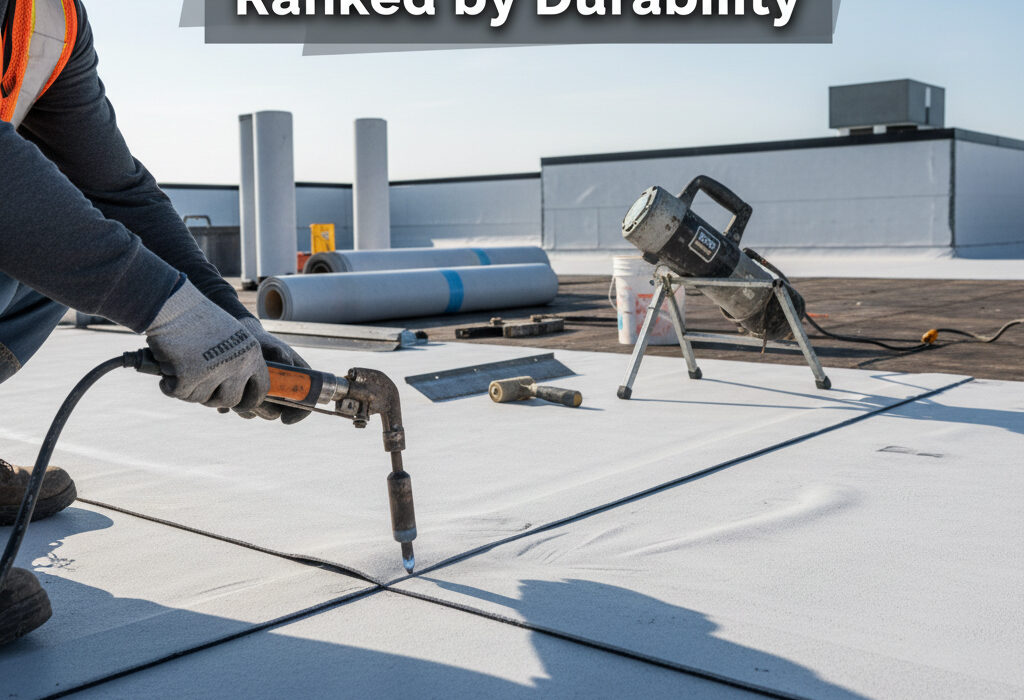
Hot-air welded seams can produce a strong, consistent bond when executed correctly. That seam performance is a major reason PVC earns a leading durability position.
Chemical and grease resistance that matters on real buildings
Many low-slope roofs get exposed to HVAC condensate discharge, kitchen exhaust byproducts, and urban pollutants. PVC is often chosen where chemical resistance is a practical durability requirement, not a luxury.
Reflective surface behavior that can reduce heat stress
When a roof surface runs cooler, it can reduce stress on terminations and some details. That does not eliminate maintenance needs, but it can support more stable long-term performance in sun-heavy conditions.
The main durability risks to manage with PVC
Detailing failures, not field failures
PVC systems usually do not fail because the middle of the membrane suddenly stops working. Failures are more likely at edges, terminations, and penetrations where workmanship and compatible components matter.
Rooftop traffic still needs a plan
PVC is not immune to punctures. Walk pads and service routes remain important, especially where technicians access equipment frequently.
#2 TPO Single-Ply: High Durability Potential When Specification and Welding Discipline Are Strong
TPO (thermoplastic polyolefin) is widely used because it can balance performance characteristics that matter for low-slope roofs. Its durability can be excellent, but it is more sensitive to specification choices and installation consistency than many owners realize.
What drives durable TPO performance
Welded seams with a consistent installation process
Like PVC, TPO relies on welded seams. When crews are trained, seam prep is consistent, and welds are verified, seam integrity can be a real durability advantage.
Heat and UV behavior that supports stable performance
TPO is commonly selected for its surface properties in high-sun environments. The durability benefit comes from reducing thermal stress on the system, especially at transitions and details.
What can reduce TPO durability in practice
“TPO” is a category, not one identical product
Formulations, reinforcement, and membrane thickness vary. A strong durability outcome depends on selecting a system that fits roof conditions and is installed within manufacturer guidelines.
Seams are only as durable as their execution
Rushed work, inconsistent weld temperature, and weak edge detailing can undermine the durability upside. When we see early problems on TPO roofs, they are frequently tied to detail execution rather than a sudden membrane collapse.
#3 EPDM Rubber: Proven Track Record, with Seam Strategy as the Durability Divider
EPDM (ethylene propylene diene monomer) is a long-established single-ply rubber membrane. It can be highly durable, especially on simpler roofs, but seam strategy and detailing control its real-world ranking.
Why EPDM remains a durability contender
Flexibility that tolerates building movement
EPDM handles thermal expansion and contraction well. That flexibility can reduce stress at certain transitions, particularly on roofs with regular temperature swings.
Straightforward field membrane performance
EPDM field sheets can be resilient and stable when properly installed and protected from abuse.
Where EPDM durability is won or lost
Seams and edge preparation are critical
EPDM commonly uses taped seams or adhesives depending on system design. Long-term durability depends on surface prep, consistent pressure, clean conditions, and correct detailing at terminations.
Foot traffic requires protection zones
EPDM can be punctured by sharp impacts. A durability-first EPDM roof often includes walk paths and protection around equipment to prevent avoidable damage.
#4 Modified Bitumen: Surface Toughness and Redundancy That Works Well on Active Roofs
Modified bitumen is a multi-layer asphalt-based system that can offer a rugged surface, especially where rooftops are active and puncture risk is higher.
Where modified bitumen earns durability points
Strong resistance to incidental rooftop abuse
Granulated cap sheets and multi-layer construction can make mod-bit feel more resilient under foot traffic than many single-ply options, especially when a service route crosses the roof regularly.
Redundancy that can reduce “one puncture equals one leak”
Multiple layers can help reduce the chance that a small surface issue immediately becomes an interior leak, depending on system configuration.
Durability depends on application method and detailing
Torch-applied, self-adhered, and cold-applied options exist. Each has its own risk profile. The durability advantage shows up when the system is matched to the building and installed with consistent attention to flashings, edges, and penetrations.
#5 Built-Up Roofing (BUR): Multi-Ply Protection with Higher Detail Sensitivity
BUR uses multiple plies of reinforcing layers and bitumen. It can be durable, but it also demands careful detailing and attentive maintenance to preserve its strengths.
Where BUR can be durability-forward
Layered construction that resists minor damage
With multiple plies, BUR can offer robust protection in some environments, especially when the roof assembly and building support the system correctly.
The durability cautions with BUR
Repairs and modifications must be handled carefully
Penetration changes and rooftop work can be more disruptive if not managed with a clear repair strategy. Durability stays high when rooftop changes are planned and executed with compatible materials and workmanship.
#6 Spray Polyurethane Foam (SPF): Seamless Coverage with Coating-Dependent Durability
SPF is unique because the foam creates a monolithic surface, and the protective coating is what shields it from UV and weathering. It can be a good durability fit in specific scenarios, but it is conditional.
Where SPF can be a practical durability choice
Complex roofs with many penetrations
Because SPF forms around irregular shapes, it can create continuous coverage where detailing would otherwise be complicated.
The durability limit that owners must accept
Coating condition is the durability gatekeeper
If the coating wears and foam becomes exposed, durability drops quickly. SPF durability depends on routine observation and timely coating maintenance, especially in high-sun environments and on roofs with frequent traffic.
#7 Engineered Low-Slope Metal Systems: Long Material Life with Less Forgiving Leak Pathways
Metal systems designed for low slope can be durable, but they are not the same as a typical membrane roof. Their durability depends heavily on panel design, joints, fasteners, and movement control.
Why low-slope metal can be durable
Metal as a material can be long-lasting, and some engineered systems perform well when properly designed and installed.
Why low-slope metal ranks lower for typical “flat roof” durability decisions
Low-slope metal is less forgiving of joint and fastener issues under water load. Thermal movement, detailing at transitions, and penetrations can become durability constraints if the system is not engineered and installed specifically for the slope and water behavior of the roof.
Durability Scorecard for Flat Roof Materials
The table below compares durability drivers without leaning on warranty language or unrealistic expectations. Performance varies with specification, thickness, attachment methods, and detailing.
| Material | Seam or joint approach | Durability strengths | Common weak zones to manage | Best-fit roof conditions |
|---|---|---|---|---|
| PVC | Heat-welded seams | Strong seam integrity, chemical resistance | Terminations, penetrations, poor weld execution | Roofs with contaminants, frequent service traffic |
| TPO | Heat-welded seams | Good surface behavior in sun-heavy areas, durable seams when executed well | Inconsistent welds, weak detailing, under-specified systems | General low-slope replacements with strong quality control |
| EPDM | Taped or adhered seams | Flexibility, proven field performance | Seams, edge prep, puncture risk in traffic zones | Simpler roofs with controlled traffic |
| Modified bitumen | Multi-layer cap sheets | Surface toughness, redundancy | Transition details, attachment consistency | Active rooftops, high puncture exposure |
| BUR | Multi-ply assembly | Redundancy, robust assemblies in the right context | Detail sensitivity, modification complexity | Buildings designed for the system, owners planning disciplined upkeep |
| SPF | Monolithic foam with protective coating | Seamless coverage on complex shapes | Coating wear, impact vulnerability | Complex penetrations, owners willing to monitor coating condition |
| Low-slope metal | Panels and engineered joints | Strong material longevity | Joints, fasteners, movement at transitions | Engineered low-slope assemblies with specialized detailing |
The Detail Zones That Decide Whether a Durable Material Stays Durable
Material selection sets the baseline, but details determine whether that baseline holds. When we investigate leaks, we rarely find a failure in the middle of a roof field. We find pathways created by transitions, penetrations, and edges.
Flashings and terminations that protect the perimeter
Parapet walls, coping, and edge metal transitions
Edges see wind, movement, and water concentration. Durability improves when the system uses compatible edge components, clean termination strategies, and secure attachment that matches the roof’s loads.
Corners and changes in plane
Inside and outside corners are stress concentrators. A durable roof treats corners as engineered details, not afterthoughts.
Penetrations that behave like miniature roof systems
HVAC curbs, vents, skylights, and pipe clusters are durability pressure points. Long-term performance depends on correct boots, properly formed corners, and transitions that maintain water shedding and seam integrity. If rooftop equipment is expected to change, durability planning includes a strategy for future penetrations and repairs that does not compromise the roof system.
Drainage design as the hidden durability backbone
A roof with imperfect drainage is a roof that experiences more stress. Scuppers, internal drains, and gutters each have their own failure modes, especially when debris accumulates. Durability-minded roof planning often includes cleaning access, redundancy where appropriate, and slope corrections that reduce standing water risk.
The Layers Under the Membrane That Quietly Control Durability
Many flat roof problems are not caused by the top layer alone. They are caused by what the top layer is forced to endure because of what lies beneath.
Cover boards as an impact and puncture buffer
Cover boards can reduce puncture risk and protect the membrane from minor impacts and traffic. They also create a more stable surface for adhesion or fastening, which helps maintain detail integrity.
Insulation stability and fastening patterns
Movement and compression in insulation can translate into stress at seams and flashings. A durability-first system treats fastening patterns and substrate preparation as structural components of performance.
Moisture control and vapor considerations
Trapped moisture can turn small issues into large ones. The goal is not to claim a roof will never see moisture. The goal is to design the assembly so that moisture risk is managed, detected early, and corrected before it compromises the system.
Durability by Roof Use: Designing for Foot Traffic and Rooftop Work
A flat roof is often a work surface. That reality should shape material selection and protective detailing.
Service routes and walk protection that prevent avoidable failures
If technicians will access rooftop equipment, durability goes up when a clear, protected service route is created. Walk pads, sacrificial layers, and designated pathways reduce punctures and reduce wear where it is predictable.
Rooftop upgrades and modifications without durability penalties
Solar installations, HVAC replacements, and new vents can introduce new leak pathways. Durable planning includes a rule: any penetration is treated as a system detail, not a hole. That means compatible materials, correct flashing strategy, and post-work verification.
When evaluating the right approach for your building, working with a contractor who routinely manages low-slope detailing is a practical durability strategy. Our local roofing contractor team focuses on details that keep durability intact through real rooftop use, not just day-one appearance.
Flat Roof Durability Compared with Steep-Slope Durability
Durability is not a single universal concept across all roof types. A steep-slope roof sheds water differently, and its most common failure mechanisms are different.
Shingle roofs emphasize wind resistance and water shedding by slope
Asphalt shingles rely on slope to move water away quickly. Their durability is often shaped by wind uplift resistance, ventilation, and surface wear patterns that differ from low-slope concerns like seam integrity under ponding conditions. For owners managing both roof types on a property, it helps to recognize that a durability win on one roof type does not translate directly to the other. Our shingle roof services cover steep-slope systems where durability is driven by different physics and different details.
Tile roofs can be long-lived, but watertight durability is system-dependent
Tile is a durable surface material, but the watertight performance of a tile roof depends on underlayment condition, flashings, and correct detailing at transitions. Durability planning for tile focuses on system components below the tile surface and on impact and movement realities. Our tile roof services address those system-level factors so “durable material” also means durable performance.
Durability-Smart Scope Language That Prevents Weak Links
The most durable roof material can still underperform if scope language is vague. Instead of focusing only on the membrane name, a durability-smart scope asks for the components and verification steps that reduce the most common leak pathways.
A durability checklist to require in roof proposals
Define the complete roof system components, including compatible flashings, edge details, and termination methods.
Specify membrane thickness or assembly type as a system choice, not a generic category label.
Require seam verification procedures for welded systems, with documentation of field checks.
Include a plan for protecting service routes and high-traffic zones.
Identify drainage corrections where water exit points are limited or where ponding is likely.
Detail how penetrations will be flashed, including curbs, boots, and corner transitions.
Clarify how rooftop work by other trades will be managed to protect the roof after installation.
Measurement clarity that reduces scope confusion
Accurate roof measurements support better planning for drainage, penetrations, and material quantities without turning the decision into guesswork. A satellite roof measurement report can help establish a consistent baseline for comparing scopes, especially on roofs with multiple levels or complicated layouts.
Durability Maintenance That Protects Performance Without Overpromising
A durable roof still benefits from observation and timely repairs. The safest, most honest expectation is that roofs are systems exposed to weather and foot traffic, and durable outcomes come from treating small issues early.
Material-specific early warning signs that deserve attention
Single-ply membranes (PVC, TPO, EPDM)
Look for open seams, edge lifting, punctures, and flashing cracks. These are pathway indicators. Catching them early can prevent water migration into insulation.
Modified bitumen and BUR
Surface wear, blisters, and cracks at transitions often show up before major leaks. Pay close attention to areas around drains and penetrations.
SPF
Coating wear and any exposed foam should be addressed quickly because the coating is the protective layer that preserves durability.
Inspection triggers that align with real rooftop risk
After heavy rain events, especially if you noticed standing water
After rooftop contractor work, including HVAC service or equipment changes
When interior stains appear, even if they seem minor
When debris accumulation is visible near drains or scuppers
For building owners who want a professional set of eyes without guesswork, scheduling a free roof inspection appointment helps identify seam concerns, flashing vulnerabilities, and drainage issues before they become larger system problems.
Choosing the Right Durability Tier for Your Building’s Risk Profile
The “most durable material” is not always the best match if it forces compromises elsewhere, such as poor drainage compatibility or insufficient protection for rooftop activity. A durability-first choice matches the material’s strengths to your roof’s failure risks.
Decision path: maximum failure resistance in high-stress roof environments
If your roof has frequent foot traffic, many penetrations, or chemical exposure, prioritize seam reliability, robust flashing strategy, and protection zones. Systems that perform well under abuse tend to be those that integrate strong seam approaches with smart detail design.
Decision path: balanced durability for typical low-slope buildings
For roofs with moderate traffic and standard penetrations, durability often comes from selecting a stable system and insisting on clean workmanship at seams, edges, and penetrations. In these cases, the contractor’s detail discipline can matter as much as the membrane category.
Decision path: durability through repairability on complex layouts
Roofs with unusual shapes, many transitions, or frequent changes benefit from materials and assemblies that support consistent repairs. Durability improves when repairs are straightforward and compatible with the original system.
If you want scope clarity without turning the conversation into numbers or unrealistic promises, a free roofing quote request can be used to document the system approach, detailing plan, and durability-critical scope items so the material ranking translates into a durable installation plan.
Building a Durability-First Flat Roof Plan That Holds Up Under Real Rooftop Life
Durability is a system outcome. The highest-ranked materials usually share two traits: they control seam and detail risk, and they behave predictably under rooftop conditions that owners cannot fully control, such as service traffic and imperfect drainage days.
At Smile Roofing, we treat durability as a practical commitment. We design for the leak pathways that happen most often, we protect the roof where people actually walk, we detail penetrations like they are the whole roof, and we plan drainage as a durability feature rather than a footnote. When material selection, detailing discipline, and maintenance awareness all align, the durability ranking stops being a list and becomes a roof that performs with fewer surprises.