

- By Smile Roofing
- Roofing Tips
- 0 Comment
Why aging roofs fail at the details first, not the big obvious surfaces
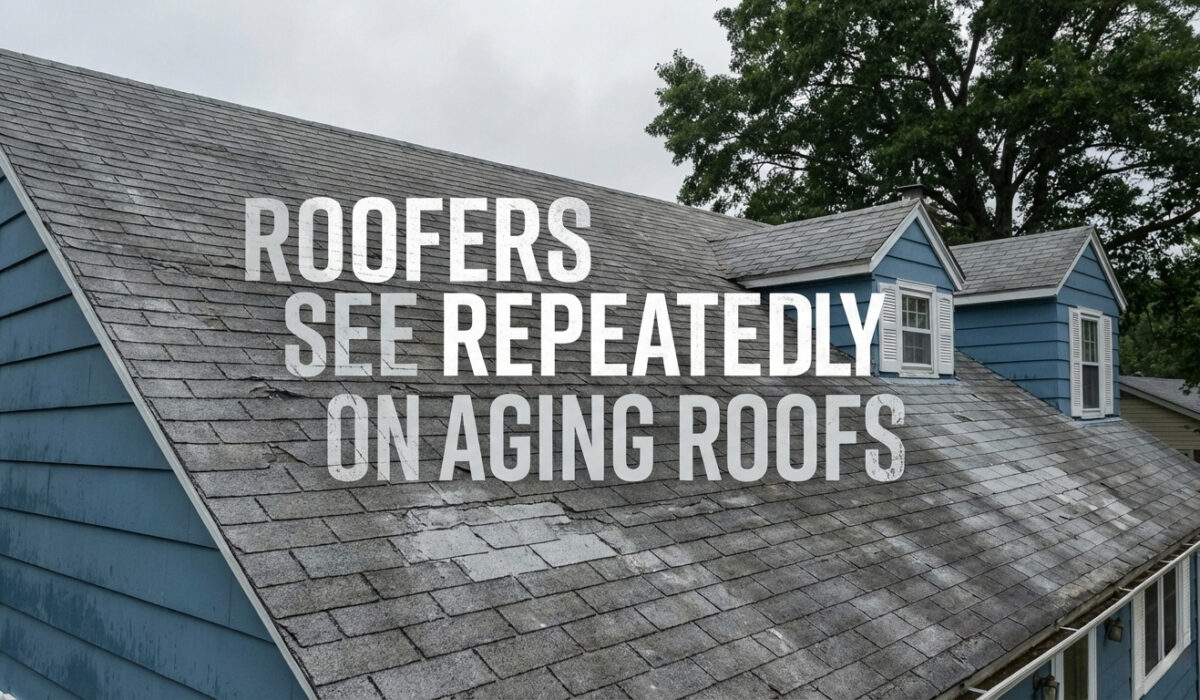
Aging roofs rarely fail because the entire roof surface suddenly becomes “bad.” More often, a roof starts failing at the details that interrupt the roof plane. Those details are where water concentrates, where materials change direction, and where movement is constant.
At Smile Roofing, we approach older roofs like systems with predictable weak links. When homeowners tell us, “The shingles still look okay,” we take that seriously and still look past the surface. A roof can look presentable while a transition or penetration is quietly losing its water-tightness.
Age versus wear versus layout: why two roofs of the same age fail differently
Two roofs can be the same age and live completely different lives. Sun exposure, slope, attic conditions, prior repairs, and foot traffic all change how fast critical components degrade. A roof with frequent maintenance visits for HVAC, solar, or satellite equipment tends to develop wear around penetrations faster than a similar roof with little rooftop activity.
The “failure map” roofers build in their heads
Experienced roofers mentally map a roof into stress zones:
Water concentration zones (valleys, low-slope transitions, drainage points)
Movement zones (edges, ridges, joints, fastener lines)
Penetration zones (pipes, vents, skylights, chimneys)
Transition zones (roof-to-wall, parapets, step-downs, additions)
Aging tends to show up first where multiple zones overlap.
Choosing a contractor who diagnoses, not guesses
The fastest way an aging roof turns into repeated repair calls is when someone treats symptoms instead of finding the true failure point. A process-driven contractor will document what is failing, why it is failing, and what needs to change so the same area does not reopen after the next storm. That is the standard we hold ourselves to as a roof repair and installation contractor.
Flashing and penetrations that quietly become leak starters
If there is one category that consistently creates repeat issues on older roofs, it is penetrations and flashing. These areas rely on layered waterproofing, precise sequencing, and materials that handle movement.
Pipe boots and vent stacks: small parts with big consequences
Pipe boots are exposed to constant sun and temperature swings. Rubber can crack, collars can split, and sealant can harden. When that happens, water does not need an obvious hole. It only needs a micro-gap at the pipe interface or a lifted edge where water can work underneath the roof covering.
Common repeat pattern roofers see
A homeowner notices a small stain after rain, someone reseals around the pipe, and the stain returns later because the boot material itself has aged out or the surrounding flashing was never properly integrated with the underlayment layers.
Skylights, attic vents, and HVAC curbs: where service visits create wear
Any roof component that gets touched during maintenance is a candidate for failure. Fasteners loosen, corners lift, sealant gets disturbed, and water finds the easiest path. On older roofs, even careful service work can expose how close a detail was to failing.
What matters more than sealant
Sealant is not a substitute for correct flashing. Sealant is a supplement. When a roof depends on sealant alone, it is often a sign the underlying detail is not doing the heavy lifting anymore.
Chimneys and roof-to-wall transitions: the funnel effect
Chimneys and walls create vertical surfaces that shed water onto the roof. If step flashing, counterflashing, or termination details open up, water gets driven behind the roof system and travels before it shows up inside.
Kick-out flashing and sidewalls
At roof-to-wall transitions, a missing or ineffective kick-out flashing can send water into the wall assembly rather than out into the gutter path. Over time, that can create both roof leaks and wall damage, which is why roof-to-wall checks are a core part of any aging-roof assessment.
Valleys and geometry problems that concentrate water where roofs age fastest
Valleys are designed to move water efficiently. The problem is that they also concentrate volume and debris. Aging materials in valleys can deteriorate faster than the open field of the roof.
Standard valleys: high flow plus abrasion
Granules, debris, and runoff act like sandpaper over time. Once the protective surface is worn down, the valley becomes more vulnerable to water intrusion during heavy rain or when debris temporarily dams the flow.
Dead valleys and remodel tie-ins: where drainage stalls
A dead valley is a valley that does not drain cleanly. These often show up when additions, dormers, or roofline changes create a shallow channel that traps water and debris. Roofers see dead valleys repeatedly in neighborhoods with multiple remodel phases because roof geometry becomes more complex with each change.
Early clues you can sometimes spot from the ground
Dark staining lines that follow a valley path
Persistent debris buildup in the same channel
Slight distortion or unevenness near valley lines
Even when these clues are subtle, they are worth a professional look because valley failures can spread moisture wider than a single penetration leak.
Perimeter breakdown at edges, eaves, and drainage paths
Roof edges and drainage components manage runoff and protect the roof’s boundary. As a roof ages, edge details often become the first place wind and water start lifting, wicking, and backing up.
Drip edge and fascia-adjacent rot pathways
Water does not always behave like a clean waterfall off the roof. It can cling to surfaces, wick upward, and follow edges. If edge metal is missing, improperly integrated, or deteriorated, moisture can reach wood components and start rot.
Paint and wood clues that suggest perimeter moisture
Peeling paint on fascia boards
Swollen wood at corners
Dark streaking that reappears after cleaning
Gutters and downspouts: roof-life multipliers when they function, accelerators when they do not
A roof can be in decent condition and still leak if drainage is compromised. Overflow at corners, clogs at outlets, or sections that hold standing water can push moisture back toward the roof edge and into vulnerable seams.
Aging roofs benefit from drainage checks that focus on behavior, not just cleanliness. A gutter can look “clear” and still overflow if it is pitched incorrectly or if the downspout outlet is undersized for the roof plane feeding it.
Fastener fatigue and movement that create micro-gaps with macro consequences
Movement is constant on a roof. Heat causes expansion, cool periods cause contraction, and wood components move with humidity changes. Over time, fasteners can loosen and lift points appear.
Nail pops and back-out: what they mean on an older roof
A nail pop is not only a cosmetic bump. It often indicates movement beneath the shingle or fastener withdrawal from decking. Once a fastener lifts, it can create a small pathway for wind-driven rain, especially when combined with aged adhesive strips on shingles.
Why repeated spot sealing often disappoints
If a roof’s waterproofing depends on a single dab of sealant, it is vulnerable. Sealant can help in the right context, but it cannot replace layered waterproofing and mechanical flashing. On aging roofs, repeated sealant work can become a cycle because the underlying material and movement issues are still present.
Asphalt shingle aging patterns roofers diagnose quickly
Asphalt shingles often show predictable aging behaviors. The challenge is that surface symptoms do not always reveal the real failure point underneath.
When shingle systems reach a certain stage of wear, repairs become less about replacing a missing piece and more about restoring the integrity of the system details around it. For homeowners considering bigger decisions, our asphalt shingle roof replacement service page outlines shingle-focused options and what tends to be addressed during a replacement scope.
Granule loss and brittleness: when the protective layer is fading
Granules protect shingles from UV exposure and help manage heat. As granules shed, shingles can dry out, become brittle, and crack more easily. That makes edges, tabs, and ridge areas more vulnerable to wind lift and water entry.
Why slopes wear differently
South- and west-facing planes often show faster UV-driven aging. Shaded areas may look better but can collect more debris and retain moisture longer, so they can develop different issues such as localized deterioration near valleys or edges.
Ridge caps and ridge vent lines: small openings at a big transition
Ridges are high-movement zones. If ridge caps crack, lift, or lose fastener protection, water can enter and travel along the ridge or down framing members, sometimes appearing far from the entry point.
Blow-offs and tab lift: the adhesion problem
As shingles age, adhesive strips lose strength. When wind gets under lifted tabs, it can worsen the lift and expose nail lines. This is one reason roofers inspect edges and rakes carefully on older shingle roofs, even if the center field looks intact.
Flat roofs and low-slope systems where water behavior changes everything
Low-slope roofs do not shed water the same way pitched roofs do. Water can move slowly, pool in low areas, and stress seams and transitions. If you are evaluating a low-slope roof, our flat roof replacement and repair service page covers common flat-roof approaches and the kinds of conditions that often prompt evaluation.
Ponding water as a diagnostic signal
Ponding water is not just an inconvenience. It is a sign that drainage is not behaving as intended. Over time, ponding can stress seams, fatigue membranes, and contribute to substrate deterioration.
Where ponding problems usually start
Slight low spots created by settling or framing changes
Drain or scupper restrictions from debris
Transitions where slope changes create a catch basin
Seams, terminations, and penetrations: the flat-roof leak triangle
Flat roofs rely on seams and terminations to remain intact through temperature swings. Aging shows up as seam separation, edge lifting, and compromised penetration seals, especially after rooftop equipment service.
Parapet walls and coping: the behind-the-wall pathway
On many low-slope roofs, the leak is not through the middle of the roof. It is behind a parapet, at coping joints, or where wall-to-roof transitions have opened. These areas often create leaks that are intermittent and hard to trace without a systematic inspection approach.
Tile roofs where the waterproofing layer can fail while the tile still looks good
Tile roofs can be visually deceptive. Tile sheds water, but the waterproofing layer beneath is what protects the structure. Many tile-roof leak calls come from underlayment fatigue, flashing transitions, and accessory failures rather than a dramatic tile break.
If your property has tile, our tile roof replacement and repair page reflects how tile systems are evaluated and why underlayment condition matters as much as what you see from the street.
Slipped or cracked tile: when it matters and when it is the symptom
A single cracked tile can be a direct entry point, but more often, isolated tile issues are clues. They may indicate movement at hips, ridges, or penetrations. They can also reveal that fasteners or mortar details are deteriorating.
Debris and bird-stop issues at eaves
Tile roofs can trap debris near eaves and at transitions. When debris builds up, it redirects water and can increase wear on underlayment laps. This is one of the reasons roofers look closely at eave closures, bird stops, and the “hidden” areas where tile meets the roof edge.
Mortar and ridge details: aging at high-movement lines
Mortar at ridges and hips can crack with movement and temperature changes. When it fails, water can infiltrate and travel along the ridge line before showing up in an interior ceiling.
Hidden system failures: underlayment breakdown, decking softness, and trapped moisture
Some of the most important aging-roof failure points are not visible from the outside. Underlayment can become brittle, tear, or lose integrity at laps. Decking can soften from slow moisture intrusion. Ventilation imbalances can accelerate heat aging and condensation issues.
Underlayment fatigue: the layer doing the real waterproofing work
Underlayment issues often appear first at transitions and penetrations, not in the open field. When underlayment fails at laps or becomes fragile, even a minor surface disturbance can turn into a leak.
Decking clues roofers take seriously
Soft spots, subtle sag lines, and recurring stain patterns in the attic can indicate prolonged moisture exposure. These conditions matter because repairs may need to address more than the visible surface component.
Moisture from inside the home: the overlooked contributor
Bathroom fans, dryer vents, and other exhaust paths should discharge outside properly. When moisture is routed into the attic, it can create condensation that mimics a roof leak and accelerates wood and fastener deterioration.
Why the interior leak stain rarely identifies the true entry point
One of the most frustrating experiences for homeowners is fixing what looks like the problem area, only to see the stain return. That is because water can travel.
How water travels on a roof system
Water can follow:
Underlayment laps
Roof decking seams
Rafters and trusses
Valley channels and flashing lines
A stain in a hallway ceiling might originate from a penetration several feet away, or even from a higher roof plane that drains toward the area.
Wind-driven rain and “sideways” leaks
Some leaks show up only during specific storms because wind pushes water into details that normally shed water fine. That is why roofers ask about storm direction, rainfall intensity, and whether the leak occurs only under certain conditions.
Pre-measured roof data that helps pinpoint risk areas before anyone climbs
Aging roof diagnosis improves when measurements and roof layout are clear. Pre-measured information helps identify roof planes, edges, penetrations, and geometry changes that are commonly involved in repeat failures.
For homeowners who want a data-first starting point, a satellite roof measurement report can reduce guesswork and make conversations about roof geometry and scope more precise.
What pre-measured roof data supports during diagnosis
Mapping roof planes and transitions that concentrate water
Identifying penetrations and features that need close inspection
Reducing errors that come from eyeballing complex rooflines
Pre-measured data does not replace an on-site evaluation, but it can strengthen planning and documentation, especially on complicated layouts.
Inspection standards that keep aging-roof decisions grounded in evidence
A thorough inspection is not a quick glance. It is a structured process that checks the roof surface, the details, and the interior signs that confirm root cause.
If you want an evaluation without pressure, scheduling a free roof inspection creates a clean starting point for understanding what is happening now and what may need attention next.
Exterior checks that focus on repeat failure points
Aging-roof inspections should prioritize:
Penetrations and flashing condition
Valleys and debris behavior
Edge details and perimeter metal
Drainage paths on low-slope areas
Signs of prior repairs that may be masking a larger issue
Interior and attic checks that confirm the pathway
Interior checks help verify whether a stain is active moisture, old staining, or condensation. Attic observations can reveal:
Moisture trails on framing
Darkened decking near penetrations
Ventilation imbalance indicators
Insulation disturbance or compression
Documentation that makes recommendations more trustworthy
We believe homeowners deserve to see what we see. Photos, annotated problem areas, and a prioritized list of what is urgent versus what is worth monitoring can turn a confusing situation into clear decision-making.
Repair versus replacement decisions built around repeatable thresholds
The goal is not to sell a bigger project. The goal is to stop repeat failures. On aging roofs, the repair-versus-replacement question often comes down to whether the failures are localized or systemic.
Localized failure: when a targeted fix can be durable
Localized issues tend to be:
A single penetration detail that has aged out
A small, clearly defined flashing problem
A limited area damaged by debris or impact
When the surrounding materials are still in good condition, targeted work can make sense.
Systemic failure: when repeat points suggest the system is aging out
Systemic issues tend to show up as:
Multiple leak-adjacent details failing at once
Widespread brittle materials or repeated fastener lift
Underlayment fatigue across multiple transitions
Recurring leaks that “move” from area to area
Failure-point triage table used for aging-roof diagnosis
| Repeat failure point | What roofers typically observe | What usually causes the repeat | Why it keeps coming back | Practical next step |
|---|---|---|---|---|
| Pipe boot and vent penetration | Cracked rubber, split collar, disturbed seal | UV aging and movement | Sealant becomes the primary defense | Replace or rebuild the penetration detail correctly |
| Chimney or wall transition | Gaps at step flashing, separation at termination | Movement plus layered flashing breakdown | Water travels behind the surface | Rework flashing integration with surrounding layers |
| Valley channel | Debris buildup, worn surface protection | Concentrated flow and abrasion | Minor dams redirect water under materials | Clear debris and assess valley detailing integrity |
| Roof edge and eave line | Lifted edges, fascia staining, perimeter softness | Wind exposure and edge detail deterioration | Wicking and overflow recur during storms | Restore edge protection and verify drainage behavior |
| Flat-roof seam or termination | Seam separation, edge lift, soft spots nearby | Thermal cycling and ponding stress | Water stays in contact longer | Rebuild seam and address drainage or low spots |
| Tile roof underlayment zone | Leaks with tiles still intact | Underlayment aging beneath the tile | Surface appearance hides layer failure | Evaluate underlayment and transition detailing |
Quote quality on older roofs, where scope clarity matters more than a single line item
Aging roof projects can vary widely because hidden conditions may not show until work begins. That is why quote structure matters. A good quote explains what is included, what is excluded, and how unexpected conditions are handled without surprises or vague language.
For homeowners who want a straightforward starting point, a free roofing quote request should lead to clarity about scope and options, not pressure.
What a responsible scope description should include
Look for clarity around:
Whether flashing at key transitions is being replaced or reused
How roof edges and drainage tie-ins are addressed
How ventilation and moisture-related conditions are evaluated
What documentation you receive about problem areas
Comparing quotes without over-simplifying the decision
Comparing bids is hard when scopes are not aligned. If two quotes recommend different levels of flashing work or different approaches to valleys and transitions, the difference is not only materials. It is the strategy for preventing the same failure points from returning.
A homeowner-safe routine that targets the next likely failure point
Aging roofs benefit most from consistent attention to the areas that repeatedly fail. The safest approach is observation from the ground and from accessible interior spaces. Roof climbing is a common cause of injuries and accidental damage to aging materials.
The 10-minute ground-and-attic check that helps spot early failure signals
Scan roof edges from the ground for lifted lines, uneven edges, or areas that look slightly “wavy.”
Look for persistent debris buildup in valleys or roof intersections that repeatedly collect leaves.
Check gutter behavior after rain by looking for overflow marks, corner staining, or areas where water seems to miss the downspout path.
Inspect ceilings and upper walls inside for fresh discoloration, bubbling paint, or new hairline cracks near corners.
Visit the attic safely and look for moisture trails on wood, darkened decking near penetrations, or damp insulation.
Notice odor changes like musty smells that appear after storms or during humid periods.
Document changes with photos so a roofer can compare conditions over time.
How we frame the goal for aging roofs
The most realistic objective is not perfection. It is control. Control means understanding the roof’s repeat failure points, prioritizing the details that can cause structural damage, and building a plan that prevents small issues from cascading. That is how an aging roof becomes manageable instead of unpredictable.